
Recent Publications
Rethinking Angina Treatment - PharmaShots Interview
Source: PharmaShots CXO Talks
Summary
In a new episode of PharmaShots CXO Talks, Auxilius Pharma’s CEO Jed Litwiniuk, MHA, and CMO Uwe Tigör, MD, joined editor-in-chief Aditya Singh to discuss the company’s strategy for AUX-001, a once-daily, modified-release formulation of Nicorandil for chronic stable angina. The founders, who established Auxilius more than six years ago while at Columbia University’s Mailman School of Public Health, explained that the company has stayed true to its value-added medicines model under the FDA’s 505(b)(2) pathway: rather than betting on a new molecule, where fewer than 5% succeed, it takes a proven compound and makes it meaningfully better. Because Nicorandil has never been approved in the US, AUX-001 would enter the market as a new molecular entity with a mechanism of action not shared by any other approved US drug, which brings five years of market exclusivity instead of the usual three.
“You start with a proven molecule and make it meaningfully better. Done right, that can deliver enormous clinical value to patients, and it maximizes the chances of success.”
Jed Litwiniuk, MHA, CEO of Auxilius Pharma
Dr. Tigör described Nicorandil as the only anti-anginal that both relieves angina symptoms and reduces the risk of future coronary events. In his view, its potential has been held back by twice-daily dosing, which lets efficacy drop in the middle of the day, when patients are most active. He pointed to large studies from China, where Nicorandil is given three times daily to keep drug levels more stable, which reported better outcomes, including a 45% reduction in stroke risk. He also highlighted a substantial and growing unmet need: around 11 million Americans live with chronic stable angina, coronary microvascular disease overlaps with large-vessel coronary disease in 60% or more of patients, and the CorCMR study led by Prof. Colin Berry in Glasgow found that 53% of patients initially diagnosed with non-cardiac chest pain in fact had microvascular disease.
Turning to the clinic, Dr. Tigör said Phase 1a confirmed that the AUX-001 prototype achieves once-daily release. The release was in fact more prolonged than needed, so the formulation has since been further optimized. Vasodilator headaches were effectively managed and will be addressed prophylactically in Phase 1b. Heart rate and blood pressure remained stable, and the QT interval changed by only about one millisecond. He stressed that once-daily dosing is essential for adherence: chronic angina patients typically take 8 to 12 medications, and in one recent study 56% were not taking their anti-anginals as prescribed.
“There was no doubt in our mind right from the beginning that only once a day will do.”
Uwe Tigör, MD, CMO of Auxilius Pharma
Looking ahead, Mr. Litwiniuk called the manufacturing agreement with Skyepharma, a French CDMO specializing in modified-release oral solid dosage forms, an important milestone that can scale with the program through Phase 3 and commercial supply. He described the July Type C meeting with the FDA, held with the support of Premier Research (which acquired Camargo), as productive, noting that the FDA expressed its willingness to continue to engage with the sponsor. Auxilius plans to file the IND at the end of the first quarter of 2027 and to start a Phase 1b relative bioavailability study in the first half of 2027, with a dog pharmacokinetic study running in parallel. Because no Phase 2 is required, a successful Phase 1b would make AUX-001 Phase 3-ready. The company is already in discussions with several US cardiovascular companies interested in the Phase 1b data, and is prepared either to partner or to take the program into Phase 3 on its own. Future opportunities include microvascular angina, heart failure in patients with chronic angina, and anthracycline-induced cardiotoxicity, alongside the second pipeline candidate, AUX-002.
Watch the full interview
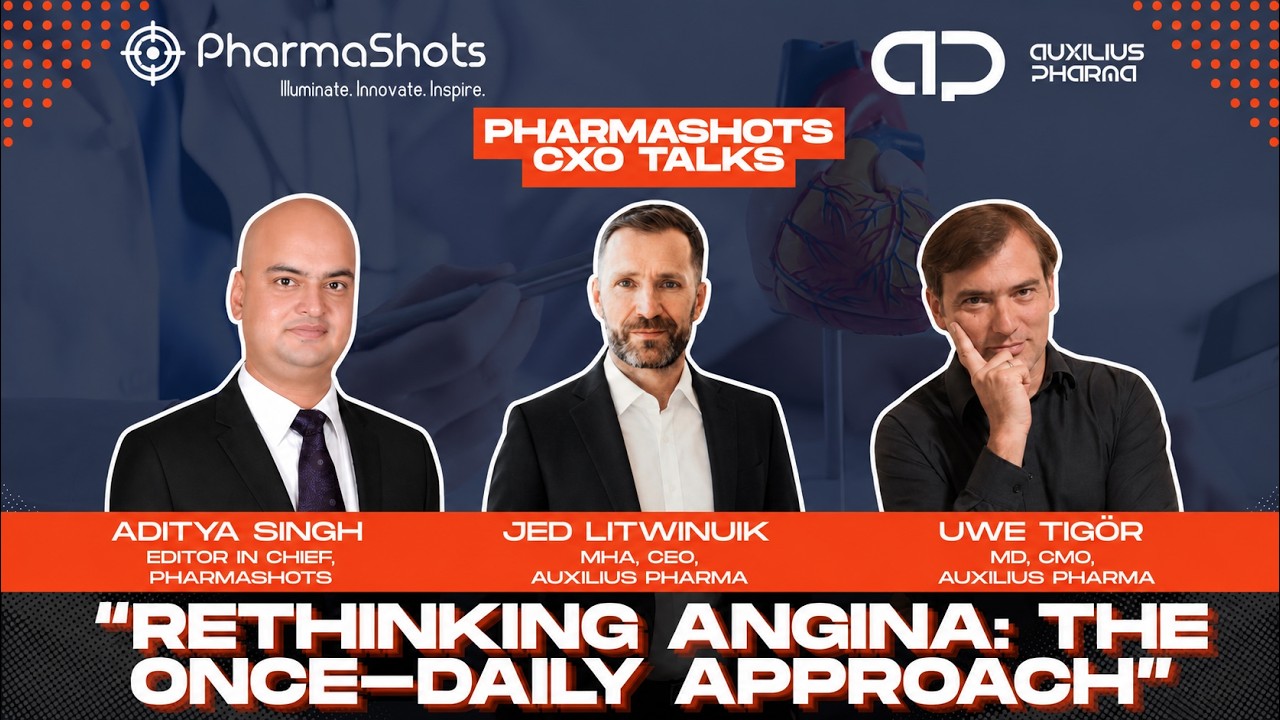 PharmaShots CXO TalksRethinking Angina Treatment: Auxilius Pharma's Strategy for AUX001 | PharmaShots CXO Talks
***
About Chronic Stable Angina
Chronic Stable Angina Pectoris (CSAP) is one of the most common cardiovascular conditions, affecting more than 11 million patients in the US and over 16 million in the EU. It is the most frequent symptomatic manifestation of atherosclerotic coronary artery disease (CAD), characterized by chest pain or discomfort due to inadequate myocardial blood flow, typically triggered by physical exertion, emotional stress, or other factors. Recent research highlights that a considerable number of chronic angina patients suffer not only from disease of the larger coronary arteries but simultaneously also from coronary microvascular disease (CMD), which will put further demands on the capability of future anti-angina medications.
About AUX-001
AUX-001 is an innovative, once-daily, extended-release formulation of Nicorandil. For decades, immediate-release, twice-daily Nicorandil has been a cornerstone treatment for chronic angina symptoms outside the US. It is distinguished by its dual mechanism of action, targeting both the micro- and macrovascular coronary artery flow bed and providing sustained relief of angina symptoms without the common issue of tachyphylaxis seen with other anti-anginal vasodilators, such as long-acting nitrates. AUX-001 offers efficacy comparable to conventional anti-anginal medications such as beta-blockers, calcium channel blockers, and long-acting nitrates, while also potentially enhancing control of the underlying coronary disease and reducing angina-related hospitalizations, as demonstrated in the IONA study.
About Auxilius Pharma S.A.
Auxilius Pharma is a privately held pharmaceutical company that commenced operations in 2019. Auxilius operates in the space of value-added medicines and brings innovation to areas of high unmet need for patients with diseases such as chronic stable angina pectoris, with the aim of positively impacting public health. Auxilius Pharma’s R&D Strategy is driven by patients’ need for affordable medications to manage their chronic conditions in the US and in other major markets.